
Armadillos, Sloths & Anteaters
(Xenarthra)
Xenarthrans are an ancient order of mammals comprising 29 species in the Armadillo (Dasypodidae) family, the Anteater (Myrmecophagidae) family, and the sloth (Bradypodidae & Megalonychidae) families. They are mostly insectivores and herbivores of small to medium body size. Armadillos are by far the most diverse group of xenarthrans, with a total of 26 living species, all in the Americas. Only the species below is found in the United States.
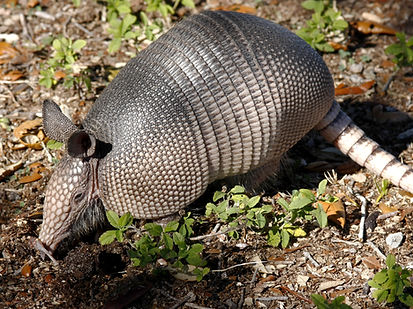
Nine-Banded Armadillo
(Dasypus novemcinctus)
Observed in the Park
The armadillo is a unique animal who’s body is covered with an armored carapace (a double layer of horn and bone), segmented into three main divisions: an anterior scapular shield covering the shoulder; a posterior pelvic shield covering the hip region; and a middle section
comprised of a series of bands connected by soft, infolded skin between the bands. The head and legs are covered with thick scales, and the tail is encased in a series of bony rings. Coloration is generally grayish brown, with yellowish-white scales along the side of the carapace. The armadillo has a long, pointed snout, small eyes, and large, cylindrical ears. The armadillo’s pointed snout, short, stout legs, and heavy claws are well suited for digging and burrowing. They are 24 to 31 inches long and weigh 8 to 15 pounds. A major portion of the armadillo’s time spent outside its burrow is devoted to feeding. They typically start foraging as they emerge from their burrow and move at a slow pace following an often erratic course. Prey is apparently detected by smell, although sound also may play a role. Typical foraging behavior involves quickly probing with the nose and occasionally pausing to dig for prey. Armadillos are opportunistic feeders and consume a wide variety of food items. Invertebrates, primarily insects, make up roughly 90 percent of their diet. Small vertebrates and plant material make up the remainder of their diet. Researchers also have seen evidence of armadillos feeding on small reptiles and amphibians, the eggs of ground-nesting birds, and carrion.