Rodents (Rodentia)
Rodentia is the largest order of mammals. Out of some 4,000 species of mammals, around 1,500 are Rodents. In addition to mice, rats, hamsters, and guinea pigs (which are commonly known and often kept as pets), the order also includes beavers, muskrats, porcupines, woodchucks, chipmunks, squirrels, prairie dogs, marmots, chinchillas, voles, lemmings, and many others. They are found on all continents but Antarctica. Rodents have a single pair of incisors in each jaw for gnawing, no canines, and just a few molars in the back of their jaw or chewing. Most rodents are herbivorous, but some are omnivorous, and others prey on insects. Rodents cost billions of dollars in lost crops each year, and some are carriers of human diseases such as bubonic plague, typhus, and Hanta fever. However, various rodent species are economically important as sources of food or fur in many parts of the world, and others are used extensively in biomedical research.

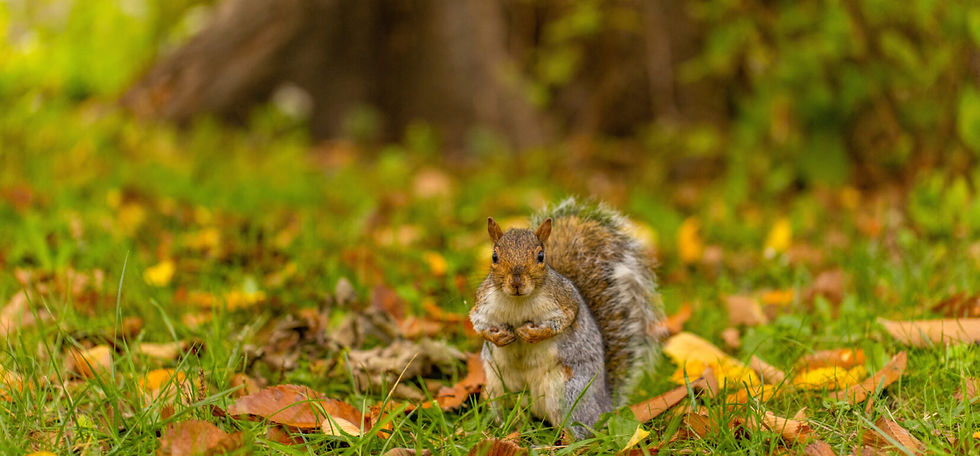
Eastern Gray Squirrel
(Sciurus carolinensis)
Observed in the Park
These common medium-sized tree squirrels range from 16 to 20 inches in length and weighs 1 to 1.5 pounds. Their grayish-looking hair is actually a mix of black, white, and brown banding on each individual strand. Their undersides are white with some cinnamon color flanks on the face and sides just behind the front shoulder, and their lighter gray tail hairs are
tipped with white. Gray squirrels are crepuscular. In the winter, they prefer acorns, nuts, and other seeds and in the spring and summer, they also eat a variety of plant buds, insects, agricultural crops, and even bone.
Fox Squirrel
(Sciurus niger)
These squirrels are 12 to 15 inches long in the body and weigh 2.5 to 3 pounds. Their fur color is a mixture of black, silver, and red. The upper parts of their bodies are usually gray but often have a reddish or rust shading. The bellies are reddish or orange, and the tail usually has a distinct reddish cast. Their black facial mask around the eyes and nose is a defining

characteristic and they have white-tipped noses and ears. They eat a wide variety of wild foods including acorns, nuts, seeds, fleshy fruits, buds, flowers, twigs, bird eggs, insects, tubers, roots, and fungi. Pine seeds are a favorite when available. They are opportunistic feeders and their primary foods at any given time or location will depend on which provide the most energy and nutrients for the least effort.

Southern Flying Squirrel (Glaucomys volans)
The smallest of the tree squirrels, it has a normal body weight of 2 to 4 ounces and body length of 8 to 10 inches. It has very silky gray-brown fur with a white belly and a densely furred tail. The flying squirrel is easily distinguishable by the loose fold of skin called a patagium between the wrist of the fore and hind legs. The southern
Observed in the Park
flying squirrel does not actually fly but rather uses this flap as a combination parachute and sail or glider wing. Capable of gliding distances of 80 yards or greater, southern flying squirrels can turn or change the angle of descent.
Eastern Chipmunk (Glaucomys volans)
Observed in the Park
At around 8 to 10 inches long (3 to 4 inches being the tail), this is one of the largest members of the chipmunk family. It is reddish brown on its back with five obvious black stripes separated by white or grey stripes. Its belly is white or crème and its face has light and dark striping around the eyes. Its primary foods are nuts, fruits and seeds, however, they also eat some animal matter, insects, and bone.

The chipmunk will pack food into its cheek pouches and return to its burrow to store it.

Groundhog/Woodchuck (Marmota monax)
Observed in the Park
The woodchuck is a member of the squirrel family Sciuridae and classified as a rodent. This tunneling mammal has a barrel-shaped body up to 24 inches in length and five to six inches in height. It weighs approximately 10 pounds and has a slightly flattened 6 inch fur tail. Its short, powerful
legs (four to five inches long) aid greatly with digging and tunneling. The toes on the front feet are flexible, enabling it to grasp and hold food items. The pelage or fur coloring of the woodchuck is basically brown with silver tipped guard hairs which give it a grayish to grizzled colored appearance (some can be very dark to black). It has short round ears and eyes positioned near the top of its head for surveying its surroundings from the den while keeping most of its body hidden from would-be predators. Chiefly vegetarian, it feeds on bark, twigs, roots, fruits and a variety of forbs, favorig clover, alfalfa and vegetable crops.
Common Muskrat
(Ondatra zibethicus)
Observed in the Park
The muskrat is a stocky animal with a broad head and short legs weighing one to four pounds. It's body is 10 to 14 inches long. It's scaly, sparsely-haired tail is laterally-flattened tail is about as long as its body. The pelt consists of soft, thick underfur with long, glossy dark-red to dusky-brown guard hairs. The front feet, used primarily for digging and feeding, are unwebbed with four sharp-clawed toes

and a small thumb. The large hind feet are partially webbed with stiff hairs along the toes. Muskrats frequent a large variety of habitats including saline, brackish, and freshwater streams, marshes, ditches, lakes, beaver ponds, mine pits, farm ponds, and other wetland areas. Primarily vegetarians, they relish cattails, bulrush, smartweed, duck potato, horsetail, water lily, sedges, young willow sprouts, and pickerel weed, but will eat almost any type of aquatic vegetation, including the bulbs, roots, tubers, stems, and leaves of numerous wetland plants. When vegetative food sources are low, muskrats may eat animals including crayfish, mussels, turtles, frogs, and fish.

Beaver (Castor canadensis)
Beavers are the largest Rodent in North America 29 to 80 pounds and is 41 to 46 inches in length. Their under fur is soft and fine while the outer guard hair is long and coarse. Generally brown, individuals can vary from cream to black. The hind feet are webbed and the front feet are clawed. The Beaver's naked, scaled, and flat tail is an identifying feature. Their lips, nose, and ears are all valved to seal while underwater, and the Beaver can stay under for up to 15 minutes. The beaver is an aquatic mammal that can be
found on any wet habitat that will provide adequate food sources and allow it the opportunity to create an environment by building dams. The beaver feeds primarily on the bark and cambium (soft tissue under the bark) of shrubs and trees and consumes many species, with sweetgum, willows, and poplar among favorites. They also eat lilies, pondweeds, cattails, and other aquatic plants as well as agricultural crops.
Cotton Deer Mouse (Peromyscus gossypinus)
These common mice are found statewide in dense underbrush, bottomland hardwood forests, and a variety of other habitats, including old fields, upland forests, hammocks, and swamps. This opportunistic omnivore consumes insects, spiders, slugs, and snails, but also eats seeds and fungi.


Oldfield Deer Mouse (Peromyscus polionotus)
The underside of an oldfield deer mouse's body, tail, and paws are pure white, with upper parts varying greatly in color with individuals from different populations. Inland populations range from dark brown to cinnamon. This difference in coloration is closely correlated with the color of soil and/or leaf litter in the area in which they live, presumably allowing them to better blend into their background. In all populations there is a clearly defined line
between darker upper parts of the body and white underside of their body and tail. Oldfield deermice range from 4.8-6.0 inches long and weigh 0.35-0.60 ounces. Their tails are short at 2.5 to 3 inches. They have keen senses of hearing, vision, touch, and smell. Chemical cues (pheremones) are believed to be used extensively in communication between and among individuals. They are carnivore-omnivore rodents. Although the majority of their diet is composed of seasonal seeds, they readily consume a wide variety of foods, including seeds, acorns, insects, and even small vertebrates. They have been shown to prefer animal foods over most seeds when given the choice.
Eastern Harvest Mouse (Reithrodontomys humulis)
The Eastern Harvest Mouse is poorly known. Once common in old fields containing dense stands of weeds and grasses, the population may be declining in Alabama and it is of moderate conservation concern. It's diet is primarily comprised of seeds, but it also eats insects and green vegetation.


Roof Rat/Black Rat/House Rat (Rattus rattus)
A typical adult roof rat is 12.75–18.25 inches long, including a 6.5–10 inch tail, and weighs 4–12 oz. Despite its name, the black rat exhibits several color forms. It is usually black to light brown with a lighter underside. The roof rat is one of the most widespread animal species in the world due to their adaptability to a wide range of habitats, however it is largely confined to warmer areas, having been outcompeted in cooler regions and urban areas by the
brown Norway rat (Rattus norvegicus). Roof rats are predatory animals and adapt to different micro-habitats. They often meet and forage together in close proximity. They tend to forage after sunset. If the food cannot be eaten quickly, they will search for a place to carry and hoard their food to eat at a later time. Roof rats are omnivores and eat a wide range of foods, including seeds, fruits, stems, leaves, fungi, and a variety of invertebrate and vertebrate animals.
Hispid Cotton Rat
(Sigmodon hispidus)
Observed in the Park
The hispid cotton rat is a moderately large (around 5 inches long in the body weighing 4 to 8 ounces), robust rodent with a scaly, thinly haired short (3 to 6+ inches long) tail. They have large ears which are almost hidden by their fur. Cotton rats have coarse brown-gray fur with mixed buff and black, and white undersides. Hispid cotton rats are normally herbivores and feed on roots, stems, leaves, and seeds from a wide variety of plants. Fruits, berries, sugarcane, and nuts are favored when available. Insects, eggs of ground nesting birds, and carrion are eaten when available.


Golden Mouse
(Ochrotomys nuttalli)
The golden mouse is a medium sized (5 – 8 inches long), tawny or golden colored mouse, with the underside of the body’s fur ranging from a creamy, white color to a cinnamon-orange color. They are a very docile animal that use their prehensile tail to grasp onto a tree limb or vine while traveling or feeding. Golden mice are a nocturnal and social creature. There have been as many as eight individuals observed in a single nest. They are active in all
seasons. Golden mice typically eat seeds of sumac, honeysuckle, cherry, dogwood, and greenbrier vines. In addition to seeds and vines, they also eat small insects.
Woodland Pine Vole (Microtus pinetorum)
Also known as the Pine vole, pine mouse, mole mouse, potato mouse, mole pine mouse, bluegrass pine mouse. Adult pine voles have short, thick, soft, reddish-brown fur above and grayish, washed with buff fur below. They are 4 to 6 inches long and weigh around an ounce. Their tails are short and red-brown in color. Ears are small, rounded, and only slightly longer than the fur. They feed primarily on forbs, grasses, roots, flower bulbs, and tubers, but also will eat seeds, fruits, bark, a few insects, and underground fungi.

They go above ground at night to feed on bark, fruit, and tender vegetation. They store large amounts of food in underground caches.